STEAM Skills Used by National Geographic Explorers You Can Teach
Today's students are planet savvy; they want to help the globe. Similarly, through inquiry and exploration, National Geographic Explorers are trained to solve the toughest challenges out there. Bring the two together, and you accept the National Geographic GeoChallenge, an annual project-based claiming for grades four to viii that puts students in the shoes of National Geographic Explorers. Students engage and better STEAM skills while solving real-globe issues that confront our planet. Past GeoChallenge themes challenged students to find solutions to issues such as animal migration and plastics pollution.
Here are 21st-century STEAM skills students explore while completing the GeoChallenge:
i. Inquiry and Storytelling
Research is about more than googling facts. It's about synthesizing data from reliable sources into a clear, compelling story that motivates people to act. A winning GeoChallenge team from Bradford K–8 in Littleton, Colorado, used online notation.
In class, they learned this practice by marker up articles inNational Geographic, Newsela, and other Net sources. "The kids are trained on how to wait for reliable sources," says Sean Stevinson, the squad'southward double-decker. "They are turned loose to find the data they need, and it's their responsibility to brand sure it'southward valid." Student teams submit their GeoChallenge projects for appraisement by National Geographic Explorers and staff.
ii. Videography
GeoChallenge teams create and submit a video to National Geographic highlighting the problem that needs solving and the team'southward solution. As GeoChallenge teams create these videos, students practice their presentation skills, creativity, and persuasive communication skills.
Videography besides lets students utilize fine art and technology for effective storytelling.
Stevinson explains, "It'southward about how you tell the most effective story and what tools will help you practise that."
For case, Bradford K–8 students who studied wildebeest migration asked people to sponsor the building of a land bridge to help animals cross highways safely.
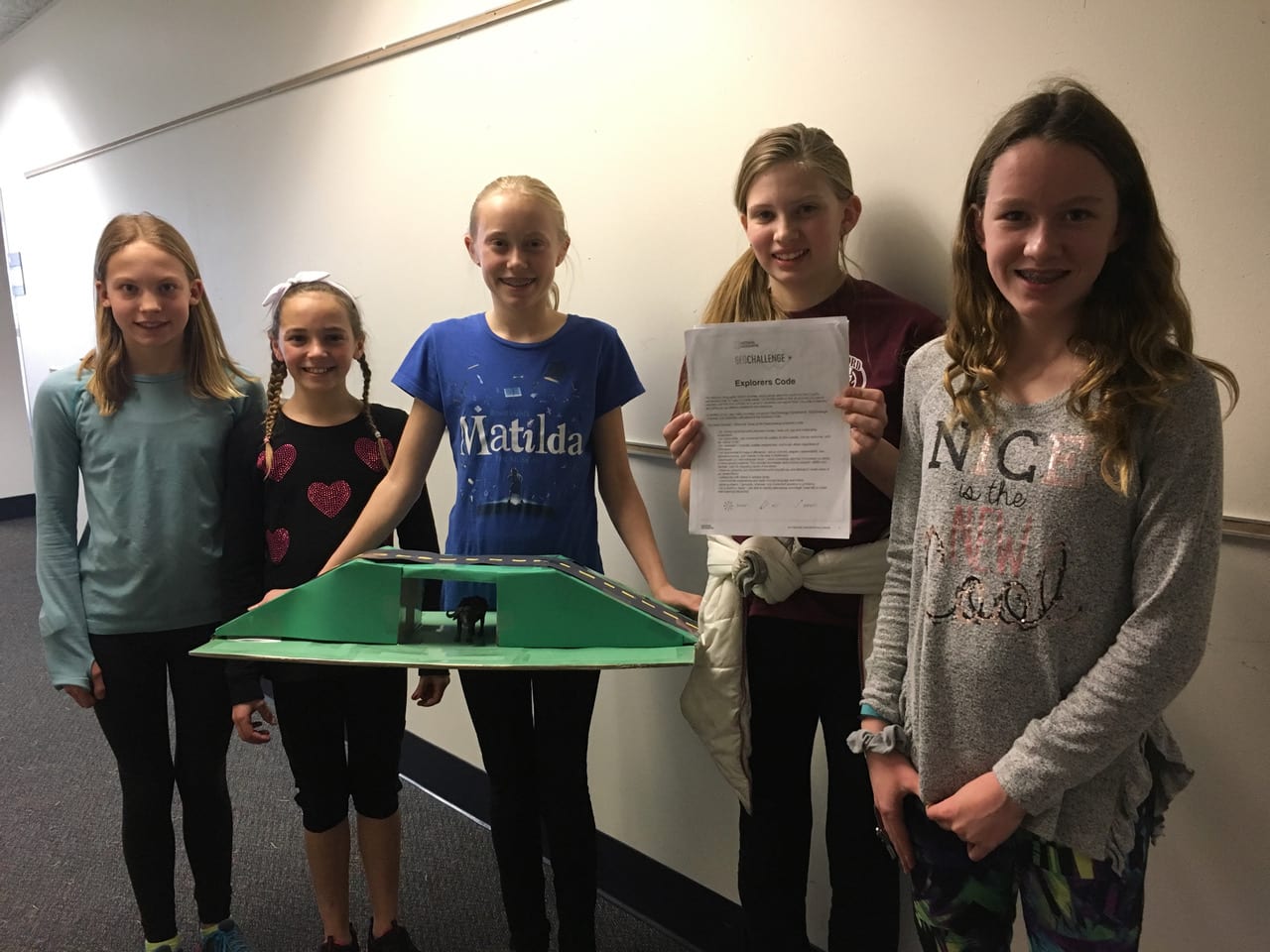
Bradford K–8 students studied wildebeest migration for their GeoChallenge project.
Source: Sean Stevinson, GeoChallenge autobus at Bradford K–8
3. Cartography
Cartography may not come to mind immediately as a 21st-century skill. Withal, whether drawn by hand or created with software, creating a map provides students the opportunity to practice math, geography, and communication skills. This places map-making solidly at the cut border of exploration.
Cathie Pearson, a gifted-support instructor and GeoChallenge coach at Woodland Hills Academy in Turtle Creek, Pennsylvania, said one of her GeoChallenge teams focused on beluga whales and created the Beluga Aid to Migration (BAM) project. As role of BAM, they created a paper map of the Chill Circumvolve, which showed the whale migration and drilling locations and how they overlapped.
Map-making helps students visualize and explain a trouble. It too involves measuring, reading maps, and making scale models of the maps, boosting students' spatial-thinking skills.
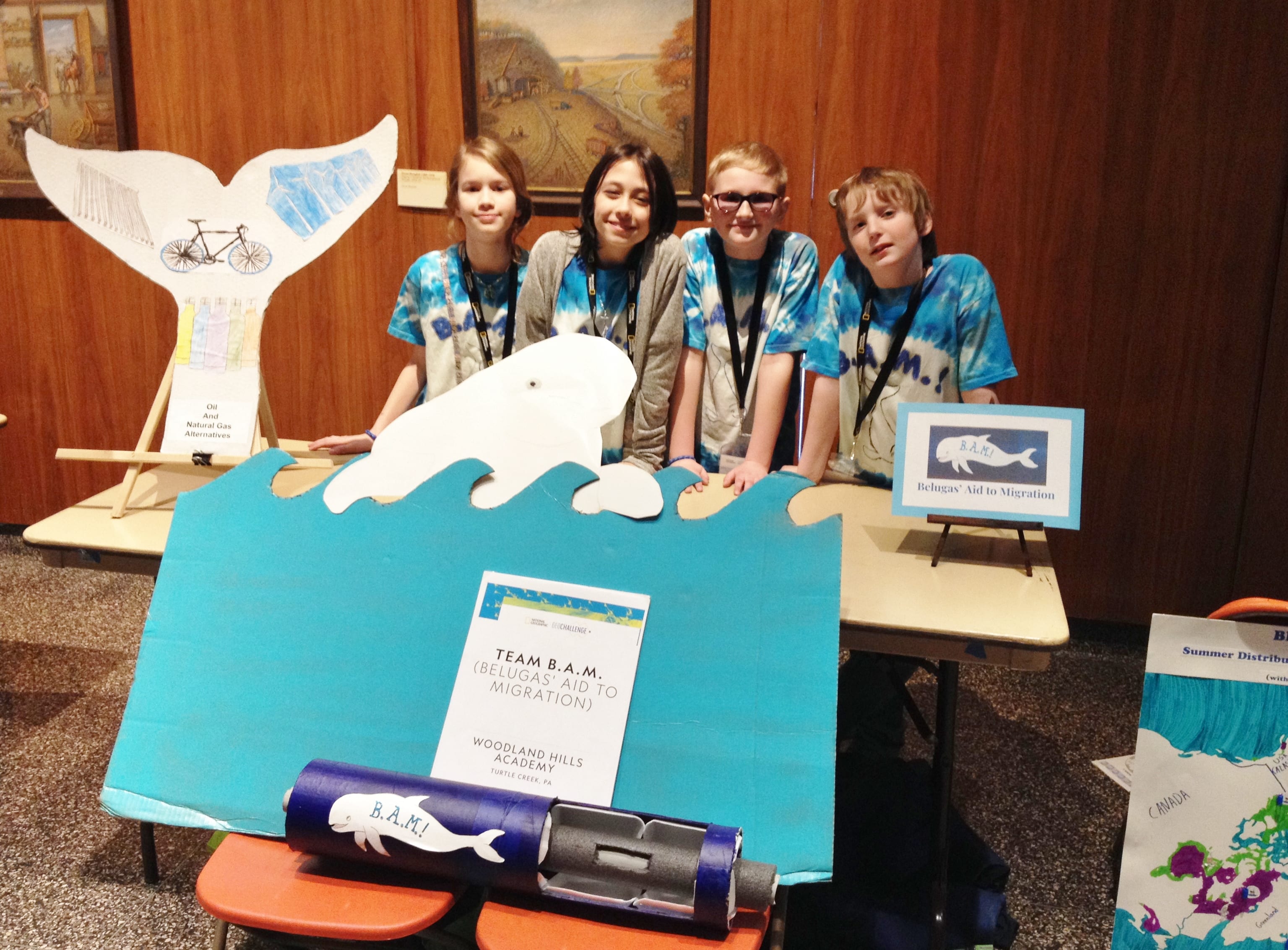
Woodland Hills Academy students studied beluga whale migration for their GeoChallenge project.
Source: Cathie Pearson, gifted-support teacher and GeoChallenge jitney at Woodland Hills University
4. Innovative Blueprint
National Geographic Explorers design solutions to real-globe issues every solar day, and so do students during the GeoChallenge. Avelino Sanquiche's students at I.S. 318 Eugenio Maria de Hostos Schoolhouse in Brooklyn, New York, researched obstacles that piping plovers confront when they migrate.
Students had to fully primary the Side by side Generation Scientific discipline Standard for Engineering science Blueprint in order to create a two-pronged arroyo to solving the problem. First, they designed drones with speakers that played the calls of prey birds, which encouraged the pipage plovers to stay away from heavily populated areas and airports. And so, they designated safety zones forth the migration route with speakers, which played mating calls to encourage birds to mate out of harm's way. Students combined familiar engineering (speakers) and new technology (drones) in new means to tackle the bug these birds faced.
"Non to be cliché," says Sanquiche, "but the GeoChallenge gave students an opportunity to think outside the box and tackle things that they otherwise would never have been exposed to."
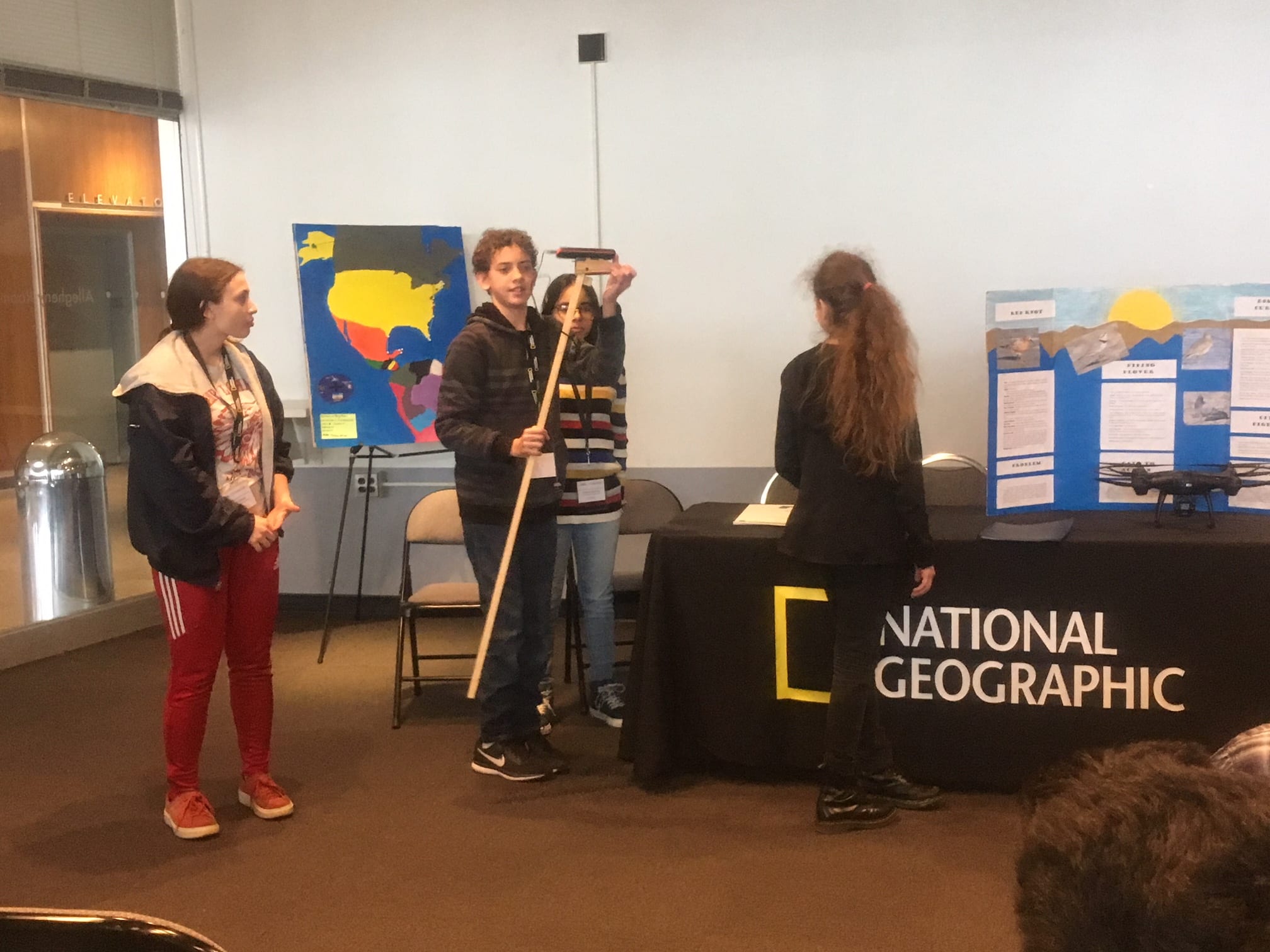
Students at I.S. 318 Eugenio Maria de Hostos Schoolhouse in Brookyn, New York, present their GeoChallenge project.
Source: Avelino Sanquiche, GeoChallenge Jitney at I.S. 318 Eugenio Maria de Hostos Schoolhouse
5. Collaboration
Like whatever project-based activity, a GeoChallenge solution won't come together without collaboration. Pearson said her students sometimes have a hard time working together. They can't permit go of their own ideas or see how working together would make a final product better.
The GeoChallenge encouraged the team to come to a consensus. Stevinson'south students came together during lunch and worked in teams outside of their firsthand friend groups.
"Their collaboration skills rose to the summit," he remembers. The project "broke down barriers between people who don't normally hang out together."
Ready to teach your students these STEAM skills?
Join the 2019-20 GeoChallenge to teach your students 21st-century STEAM skills used by National Geographic Explorers. This yr'southward claiming is Tackling Plastic! It focuses on solving problems acquired past single-use plastics, such equally straws, containers, and even contact lenses, that pollute the earth.
Click the orange button beneath to learn more than.
I Want to Learn More Most the GeoChallenge
Source: https://www.weareteachers.com/real-world-steam-skills/
0 Response to "STEAM Skills Used by National Geographic Explorers You Can Teach"
Post a Comment