When a Pastor Dies, Does His Family Leave the Church
Our green and pleasant state has played host to many notable wordsmiths through the centuries. Names similar Shakespeare, Chaucer, Wordsworth and Keats automatically leap to heed when we talk about English poetry. Only how did this proud tradition begin and who was the 'commencement' English poet? Perhaps surprisingly, the primeval recorded verse form in One-time English language has very humble origins and is credited to a shy and retiring cowherd named Caedmon.
Although Caedmon has been referred to many times in medieval literature, it is the 'Begetter of English History', the Venerable Bede (672 – 26 May 735 Advert) who starting time refers to Cademon in his seminal work of 731AD, Historia ecclesiastica gentis Anglorum (The Ecclesiastical History of the English language People). According to Bede, Caedmon tended to the animals which belonged to the Northumbrian monastery of Streonæshalch (later to get Whitby Abbey) during St Hilda's time as Abbess between 657– 680AD.
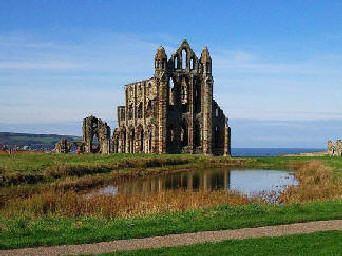
Whitby Abbey, photograph © Suzanne Kirkhope, Wonderful Whitby
As legend would have it, Caedmon was unable to sing and knew no poesy, quietly departing the mead hall whenever the harp was passed around so that he would not embarrass himself in front of his more literate peers. On i such evening every bit he fell asleep amongst the animals in his care, Caedmon is said to accept dreamt that an apparition appeared earlier him telling him to sing of the principium creaturarum, or 'the get-go of created things'. Miraculously, Caedmon suddenly began to sing and the memory of the dream stayed with him, allowing him to think the holy verses for his master, Hilda and members of her inner circle.
When Caedmon was able to produce more religious poetry it was decided that the gift was a approving from God. He went on to take his vows and get a monk, learning his scriptures and the history of Christianity from Hilda'south scholars and producing beautiful poetry as he did so.
Caedmon remained a devout follower of the Church building for the residue of his life and although never formally recognised as a saint, Bede notes that Caedmon was granted a premonition of his death following a brusk disease – an laurels usually reserved for the most holy of God's followers – allowing him to receive the Eucharist one final fourth dimension and to suit for his friends to be with him.
Unfortunately all that remains of Caedmon'southward poetry today is the ix line verse form known as Cædmon's Hymn, which Bede includes in his Historia ecclesiastica and is said to be the poem that Caedmon beginning sang in his dream. Interestingly, Bede chose not to include the One-time English language version of Cædmon's Hymn in his original version of the Historia ecclesiastica, simply instead the Hymn was written in Latin, presumably to appeal to a world-broad audience who would be unfamiliar with the Anglo-Saxon linguistic communication. The Hymn appears in Quondam English language in subsequent versions of the Historia ecclesiastica which were translated by the Anglo-Saxons from the eight century onwards.
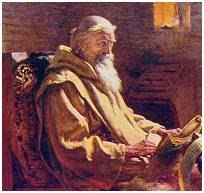
The Venerable Bede talks near Caedmon in Historia Ecclesiastica IV. 24: Quod in monasterio eius fuerit frater, cui donum canendi sit divinitus concessum – 'How in this monastery in that location was a brother, to whom the gift of song was divinely given'.
The countless translations and amendments to Bede's Historia ecclesiastica over the years mean that we cannot know the original words of Caedmon's Hymn with whatsoever certainty, particularly as many of the Old English versions would accept been a direct translation from Bede's Latin – then in upshot a translation of a translation. Bede too offers no specific dates for the Hymn, relieve to say that Caedmon lived at the Streonæshalch monastery during Hilda'due south fourth dimension every bit Abbess and that Caedmon died effectually the fourth dimension of a keen fire at Coldingham Abbey, said to take taken place betwixt 679 – 681AD.
Although originally composed to be sung aloud in praise of God, the form and construction of Caedmon'southward 'Hymn' is actually more akin to a verse form than a hymn in the tradition sense. The Hymn is also heavily alliterated and contains a break mid line, a style favoured by Old English language poetry which was itself the issue of the oral traditions being designed to be read, rather than spoken or sung.
The fanciful nature of Caedmon's inspiration for the Hymn has led many historians to uncertainty the authenticity of Bede'southward story. The traditional Anglo-Saxon poetry reserved for the worship of monarchs has as well been adjusted from the original 'rices weard' (keeper of the kingdom) to 'heofonrices weard' (keeper of the kingdom of sky) in Caedmon'south Hymn, suggesting a less divine inspiration. However, whilst it is unlikely that Caedmon'due south Hymn was the very first verse form to exist composed in One-time English, it certainly takes its place in history as the primeval surviving poetry of its kind, quite apart from its supposedly miraculous inception.
Caedmon's Hymn in Old English and its modern translation (excerpt from The Earliest English Poems, Third Edition, Penguin Books, 1991):
'Nu sculon herigean heofonrices Weard,
Meotodes meahte ond his modgeþanc,
weorc Wuldorfæder; swa he wundra gehwæs
ece Drihten, or onstealde.
He ærest sceop eorðan bearnum
heofon to hrofe, halig Scyppend:
þa middangeard moncynnes Weard,
ece Drihten, æfter teode
firum foldan, Frea ælmihtig.'
Praise now to the keeper of the kingdom of heaven,
the ability of the Creator, the profound mind
of the glorious Father, who fashioned the get-go
of every wonder, the eternal Lord.
For the children of men he made kickoff
heaven as a roof, the holy Creator.
And so the Lord of flesh, the everlasting Shepherd,
ordained in the midst as a dwelling place,
Almighty Lord, the earth for men.
Source: https://www.historic-uk.com/HistoryUK/HistoryofEngland/Caedmon-the-first-English-poet/
0 Response to "When a Pastor Dies, Does His Family Leave the Church"
Post a Comment