What Is the Minimum Memory and Processor Needed to Run a 32-bit Version of Windows 10.
Windows 10 64-flake has better performance and more than features. Simply if yous run older hardware and software, Windows 10 32-bit might be a better choice.
Windows 10 comes in two architectures: 32-flake and 64-fleck. What'due south the departure? To oversimplify it, you lot're choosing between compatibility and operation. Windows 10 32-bit is more than likely to piece of work with older hardware and software, but y'all'll miss out on some of the performance and characteristic benefits that are only available in Windows 10 64-bit. In this commodity, we'll walk you through the effectively details and so yous can choose the best architecture for your needs.
64-Bit OS
Microsoft first released a 64-scrap version of Windows in 2005. The 64-flake processor, which AMD first brought to market in 2003, unleashed many potentials, such as improved security and functioning for games and industrial applications and the power to address more memory.
For a long fourth dimension, many OEMs preinstalled 32-bit Windows on 64-bit capable systems for sound reasons. Many applications and hardware drivers remained compatible with the previous architecture for years. With the release of Windows 7 in 2009, 64-bit computing finally came into vogue. Software drivers for popular peripherals such as printers and other devices supported the newer compages. After 10 years of 64 bit in mainstream computing, there are decisions to make when considering an upgrade to Windows x.
Choosing the Right Version of Windows 10 – 32 or 64 fleck?
There are a couple of factors that should consider when choosing a Windows x architecture.
How much RAM practise you have?
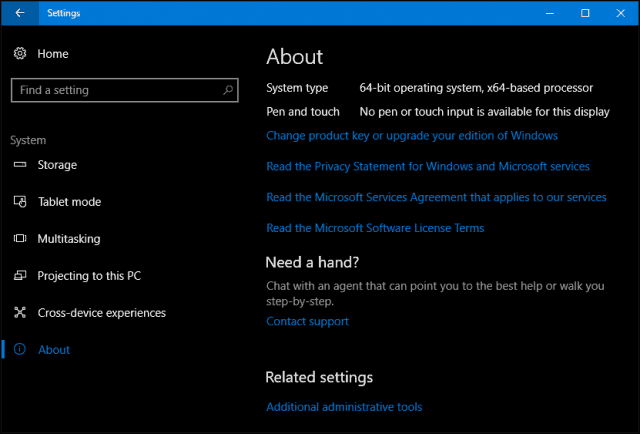
Windows 10 64-bit is recommended if yous have four GB or more than RAM. Windows x 64-flake supports up to 2 TB of RAM, while Windows 10 32-fleck tin utilise up to 3.2 GB. The memory address space for 64-chip Windows is much larger, which means you demand twice as much memory than 32-bit Windows to reach some of the aforementioned tasks. But you'll be able to perform more tasks and process more information. For example, you can take more than applications open, run an antivirus scan in the background, keep lots of browser tabs open or run multiple VMs without affecting your overall system functioning. Even though Windows ten 64-bit works best with iv GB of RAM installed, the bare minimum requirements are actually 2 GB of RAM.
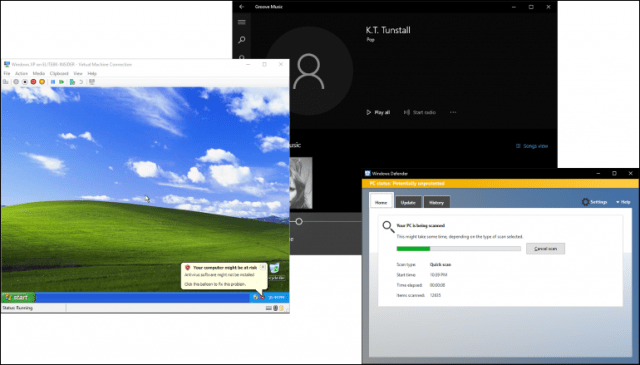
Which version of Windows vii or Windows 8 are you running?
Microsoft recommends users upgrade to a corresponding architecture of Windows ten; if y'all accept a 32-bit version of Windows 7 or 8 currently installed, yous should cull 32-bit Windows 10 and vice-versa for Windows x 64 bit. In a perfect earth, that works, but in reality, some older CPUs are only not compatible with afterwards versions of Windows 10. Read on for a prime example.
Does your CPU support the additional security features of Windows x 64-bit?
Windows 10 64-bit includes a few additional security features that aren't bachelor in Windows ten 32-fleck. For example, 64-bit versions of Windows require that all device drivers exist signed. Commuter signature enforcement means that you can only employ drivers that Microsoft recognizes. This prevents malicious or buggy drivers from existence used on your system.
Security Features
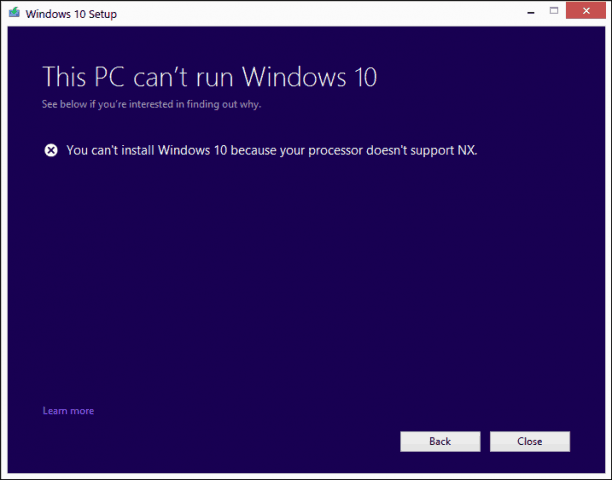
Security features similar driver signature enforcement are good, only older CPUs may not exist fully compatible with Windows ten 64-bit, even if you were running Windows vii or Windows eight 64-bit previously. This could be a result of defective the proper security instructions at the CPU level. Common errors users will encounter when attempting to upgrade to Windows 10 64-bit are the CMPXCHG16B/CompareExchange128 or CPU Not Uniform errors. Y'all can easily check if your processor supports CMPXCHG16B/CompareExchange128 past using the costless Coreinfo utility.
The release of Windows viii in 2012 introduced a new gear up of security requirements at the processor level. The unusual thing about these requirements is that some fairly recent and older CPUs might or might non include these extensions. For instance, a Cadre 2 Quad from 2008 might include the NX (No eXecute bit) or the equivalent XD (eXecute Disabled), while a 2010 Core i3 might non.
The best way to observe out is to load the BIOS or UEFI firmware, check the security category then enable it. In some cases, if the pick is non available, it is possible your system could enable the feature through a BIOS or firmware update. This will require contacting the manufacturer or checking the downloads section for the make and model of your computer for current updates. If none is bachelor, you might need to consider switching to 32-scrap Windows ten, which might work instead. If your system has more than 4 GB of RAM installed, this could hateful sacrificing some of it for the sake of compatibility.
Other hardware considerations
Choosing the compages should depend on the type of system besides. The rise of 64-fleck computing came out of the necessity for workstations requiring more than processor ability for scientific and industrial applications. The netbook grade cistron existed for a while, but the rise of tablets in the belatedly 2010s pushed them aside. Netbooks featured lower performance processors such as the Intel Cantlet. They oft came with 2 GB or less RAM. Windows 7 Starter edition was often the called operating organization for these systems, which was but available as a 32-scrap operating organisation.
Even though some Intel Cantlet processors support 64-bit Windows, the vast bulk don't run into the BIOS and c hipset level requirements. For many owners of netbooks, 64-flake Windows is just not recommended, fifty-fifty if you lot tin can run it . Netbooks were primarily designed for content consumption and light productivity tasks such as web browsing, give-and-take processing, email, streaming video, and listening to music. In this regard, 32-fleck Windows 10, if compatible, should be more than sufficient for such class factors. You can always upgrade the RAM or storage to an SSD for added functioning if this is an option with your system.
For processors such every bit the Core 2 Duo, before AMD 64 processors, and Intel 64 processors released before 2008, even if you are running a 64-fleck compatible version of Windows today, such as Vista or Windows 7, this does not mean information technology recommended or possible with Windows 10. As noted, newer operating system requirements and likewise operation might make information technology a deterrent.
In 2007 I had an Acer Ferrari 5000, which came with an AMD Turion 64-flake processor, ATI Radeon 128 Graphics, and 2 GB of RAM. Back then, that was state-of-the-art, but as Windows 10 became more powerful, the thought of trying to eek more life out of my existing hardware didn't seem reasonable. Before Microsoft developed a 64-scrap compatible operating system for the AMD 64 processor, the company noted 32-chip versions of Windows gaining a 9% operation boost from running on 64-scrap hardware. The same could exist true even for modern 32-bit versions of Windows 10.
Which applications do you rely on?
These days, for many users, 64-bit Windows ten tin can make a lot of sense, but specifically on recent or newer systems. If you need to run the latest graphics intense games, multiple virtual machines, and industrial applications such equally AutoCAD, at that place is no other option . For years now, companies such as Microsoft, Autodesk , and Adobe have released 64-bit versions of their flagship desktop applications such as Microsoft Office, AutoCAD, and the Adobe Creative Cloud.
If you must run these types of applications—peculiarly the latest versions—it is in your best interest to proceed upwards on the hardware side besides. If awarding compatibility is of import to y'all, choosing 64-bit Windows 10 might be out of the question. Since its introduction, 64-bit versions of Windows accept sacrificed sixteen-bit support. The lack of a 16-bit subsystem means users won't be able to run legacy applications designed for older versions of Windows, such as Windows iii.1. Windows x 32-bit however includes the 16-bit subsystem, but I institute it to exist extremely buggy. Y'all'll go more mileage out of a virtual machine running a compatible version of Windows for older applications.
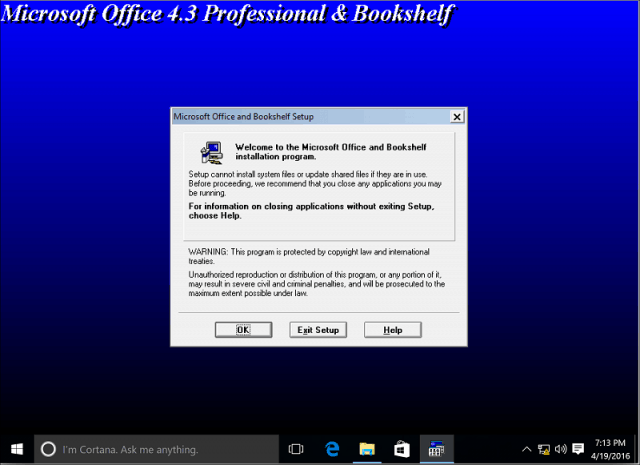
As your system ages, choosing 64 bit Windows ten might not necessarily make sense. Microsoft has not fabricated pronouncements regarding the decease of 32-bit Windows yet. Based on the millions of capable machines still out there, it would seem unreasonable to exercise so. Not to mention, if Microsoft drops them, 32-flake versions of the Linux operating system—many of which are still in active development—volition gladly pick up the slack.
Conclusion
Ultimately, your option will boil down to compatibility versus functioning. If I were to brand this simple, I would advise you to modify your expectations equally your PC ages, especially as Windows 10 matures and adds advanced features, some of which are becoming exclusive to the 64-fleck versions. For example, Hyper-V and the Windows Subsystem for Linux both require 64-flake Windows 10. Of course, this might exist a chore for users, requiring a clean install, finding application disks and setup files, backing up personal files, and preparing to drift. That said, prolonging the life of your arrangement, particularly with Windows ten'due south lifecycle, will require re-evaluating the system's capabilities every few years.

Source: https://www.groovypost.com/howto/choose-windows-10-32-bit-or-64-bit-architecture/
0 Response to "What Is the Minimum Memory and Processor Needed to Run a 32-bit Version of Windows 10."
Post a Comment