What Is the Tariff Rate of Importing Beef Into the United States
A Review of U.S. Tariff Rate Quotas for Beef Imports
Printer-Friendly PDF
The United States is the globe's largest producer of beef but information technology also imports more beef than whatsoever other country. U.S. producers specialize in raising high-value, grain-fed cattle, while the beef the The states imports from other countries is mainly lower-value, grass-fed, lean product that is processed into basis beef. Overall, imports accounted for nigh 14 percentage of U.South. beef supplies in 2015.
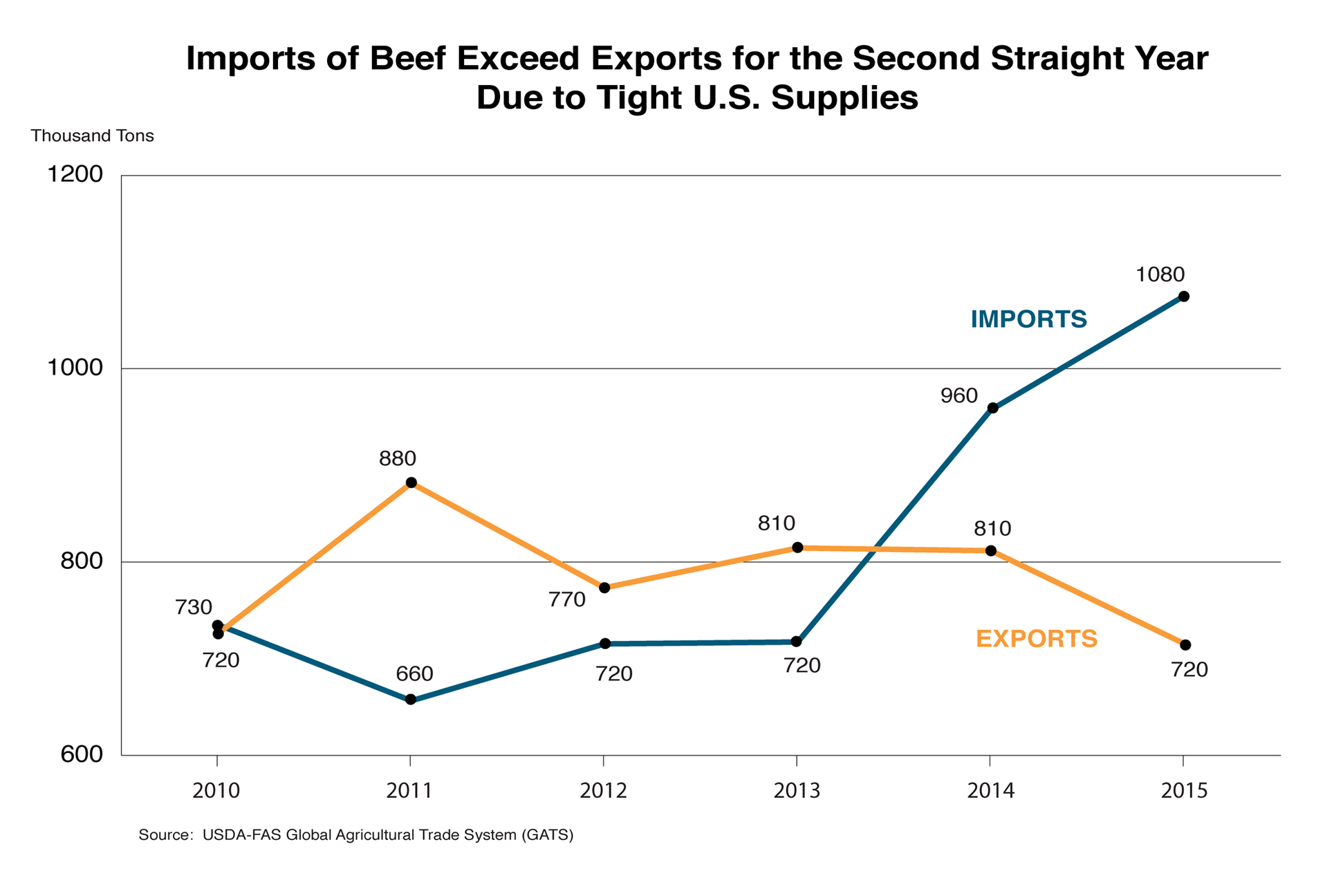
From 2011-2013, the U.s. was a net exporter of beef on a volume ground. However, imports surpassed exports in 2014 when domestic production declined most six percent. Falling production was triggered by severe drought in the Southern Plains states, also as high feed prices that caused farmers to reduce their herds between 2009 and 2014. Reductions in the cow inventory led to lower product of lean (non-grain-fed) beef, increasing demand for lean processing meat. Rise imports of both processing beef and table cuts through 2015 have offset some, simply non all, of the lower production. Expansion in the cattle sector began in 2014, spurred by high cattle prices and improved fodder weather in late 2014. U.S. beef production is forecast to increment in 2016 and lessen need for imported beef.
U.S. beef imports totaled $vi.ii billion (1.1 million tons production weight) in 2015 and exports totaled $5.2 billion (716,000 tons). The gap between imports and exports is expected to narrow in 2016 every bit higher U.S. beefiness supplies support increased exports and decreased imports.
Peak Suppliers of Imported Beef
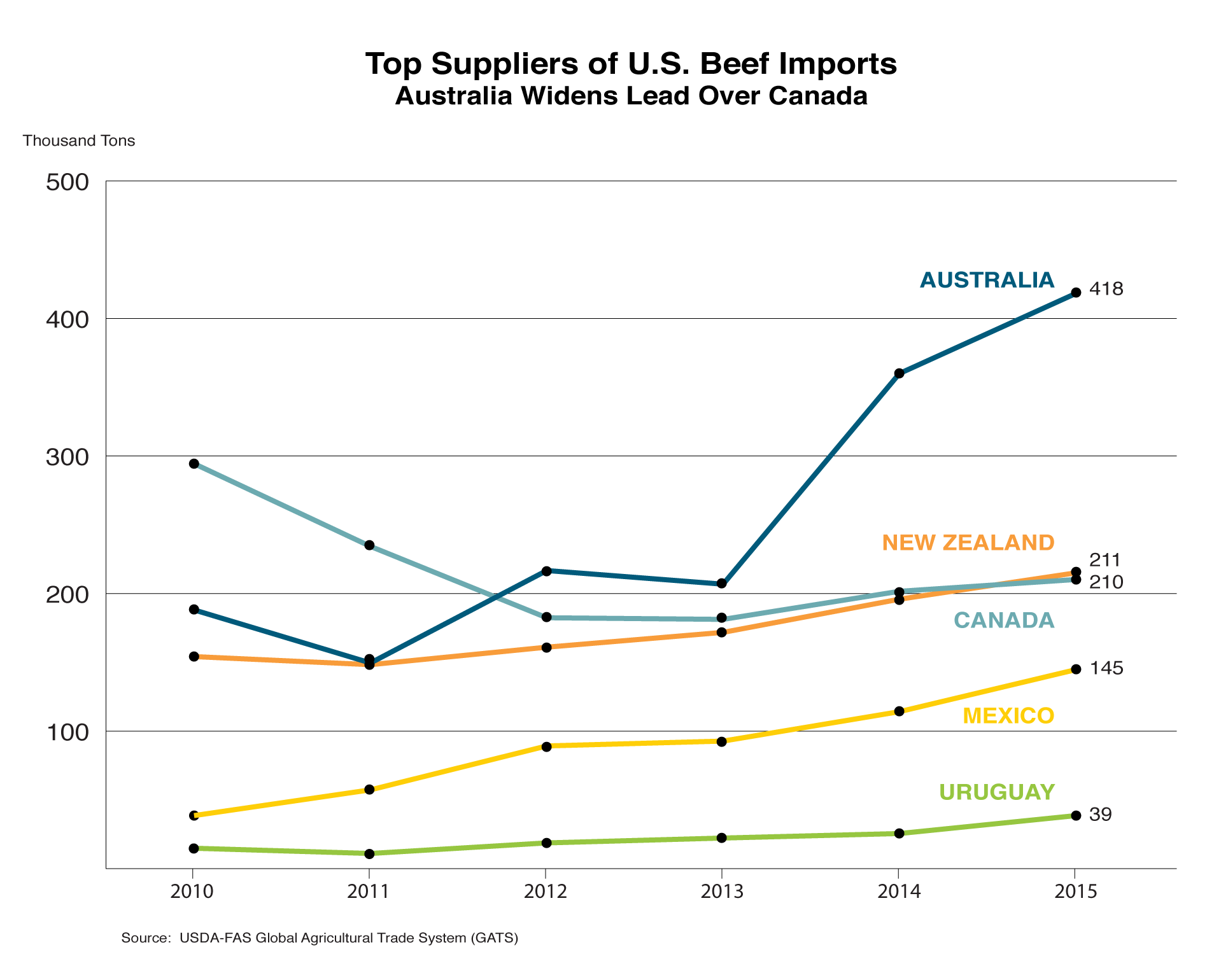
Australia was the leading supplier of U.S. beef imports in 2014 and 2015, while Canada and New Zealand were a afar 2nd and third. Shipments from Australia and New Zealand are equanimous primarily of frozen boneless beef for processing, while shipments from Canada and Mexico are typically college-value, fresh or chilled beef sold as cuts.
Sanitary Requirements for U.Southward. Beef Imports
For importers of beef to the U.s., obtaining market admission is a multi-step process. Countries must first be approved past the U.Southward. Department of Agriculture (USDA) Fauna and Plant Wellness Inspection Service (APHIS) based on animate being disease status. APHIS assesses the risks of introducing beast diseases every bit a upshot of merchandise. In improver, the USDA Food Rubber and Inspection Service (FSIS) must certify that the importing country's food regulatory system employs sanitary measures equivalent to U.S. standards. Currently, 12 countries are eligible to ship fresh or frozen beef to the United states of america: Commonwealth of australia, Canada, Chile, Costa rica, Honduras, Ireland, Japan, Lithuania, Mexico, New Zealand, Nicaragua, and Uruguay.
U.S. World Trade Organization Tariff Rate Quotas
As a effect of the 1995 World Trade Organization (WTO) Uruguay Round Agreement, the U.s. adopted a organisation of tariff rate quotas (TRQs) for imports of beefiness. The two-tiered system allows a specified volume of imports per calendar twelvemonth at a lower rate of duty and assigns a higher tariff charge per unit to volumes above the quota. Two types of U.S. TRQs were established through WTO negotiations:
- Country-Specific TRQs: Created for Australia, Japan, New Zealand, Uruguay, and Argentine republic (see table).
- Other Countries TRQ: Provides preferential-duty access for other countries that are eligible to ship beef to the United States.
| U.S. Tariff Charge per unit Quotas and Imports of Beef in 2015 | ||||||
| Country | U.Due south. Importsone | Tariff-rate Quota | Quota Fill up-Rate | Charge per unit of Duty | ||
| Tons | One thousand thousand U.s.a. | Tons | In-Quota | Above-Quota | ||
| Canada | 199,190 | $1,102 | Unlimited | N/A | 0% | Due north/A |
| Mexico | 136,104 | $1,002 | Unlimited | N/A | 0% | Northward/A |
| TRQ countries | ||||||
| Argentina | 0 | $0 | 20,000 | 0% | four.4 cents/kg | 26.4% |
| Australia ii | 412,203 | $2,469 | 418,214 | 99% | 0% | 21.1% |
| Japan | 183 | $15 | 200 | 92% | iv.4 cents/kg | 26.4% |
| New Zealand | 209,768 | $1,163 | 213,402 | 98% | 4.4 cents/kg | 26.four% |
| Uruguay | 19,760 | $238 | 20,000 | 99% | four.4 cents/kg | 26.4% |
| Other three | 44,362 | $240 | 64,805 | 68% | 4.4 cents/kg | 26.4% |
| Total TRQs | 686,276 | $6,227 | 736,621 | 93% | ||
| one Imports include fresh/chilled and frozen beef only. Prepared and candy products are not subject to TRQs. Volumes are published by Customs and Border Protection, value is published by U.S. Census Agency. | ||||||
| two Australia'due south full TRQ includes a WTO quota of 378,214 plus an FTA quota of 40,000 tons. Excludes 4,000 tons at reduced tariff. | ||||||
| 3 Open to other countries that do non have a country-specific quota. | ||||||
| Sources: U.S. Customs and Border Protection; FAS Global Agricultural Merchandise System; U.South. International Trade Commission Harmonized Tariff Schedule 2015. | ||||||
Free Trade Agreement TRQs
TRQs are also created via free trade agreements (FTAs), in which example they are typically established equally a transitional step towards duty-free access. The following agreements expanded beefiness market admission into the United States:
NAFTA: Equally of January 2008, the North American Free Trade Understanding (NAFTA) was fully implemented, resulting in duty-free and unlimited access for beef amid the United States, Canada and United mexican states. Canada and United mexican states are amidst the top suppliers of U.South. beef imports, accounting for virtually a 3rd of shipments in 2015.
Australia: Australia received additional quota access in its 2005 FTA with the United States adding to its WTO quota of 378,214 tons. The agreement allowed supplemental duty-free access of 15,000 tons in the 2nd yr after enactment with a further 5,000 tons added annually or biannually. An additional quota with a reduced duty rate of 21 percent allows 3,500 tons in the start year, rising to 7,000 tons in 2022. In 2015 and 2016, total duty-gratuitous quota access is 418,214 tons, with a farther four,000 tons at reduced-duty. Unlimited duty-costless admission begins in 2023.
CAFTA-DR: The 2004 Dominican Commonwealth-Primal America FTA (CAFTA-DR) established preferential quotas for each of the half dozen parties: Costa Rica, the Dominican Commonwealth, Republic of el salvador, Guatemala, Honduras, and Nicaragua (encounter table). TRQs are contingent on filling of the WTO "Other Countries" quota – currently available to Costa Rica, Honduras, and Nicaragua – which has notwithstanding to happen. Currently, those three countries are eligible to ship beef to the United States, and shipments totaled $229 million in 2015. Since the agreement was signed, U.Southward. beef imports from CAFTA-DR countries accept risen, totaling more than 45,000 tons in 2015. In 2020, CAFTA-DR countries will have duty-free unlimited access to the U.S. market place.
| CAFTA-DR Tariff Rate Quotas | |||
| Partners | 2015 U.S. Beefiness Imports | FTA TRQs (2016) | |
| Meg The states | Tons | Tons | |
| Republic of costa rica | $46 | 9,234 | 15,556 |
| Dominican Commonwealth | $0 | 0 | ii,520 |
| Republic of el salvador | $0 | 0 | 155 |
| Republic of guatemala | $0 | 0 | 0 |
| Honduras | $6 | 1,140 | 775 |
| Nicaragua | $177 | 34,883 | 15,500 |
| Total | $229 | 45,256 | 34,506 |
| Sources: FAS Global Agricultural Trade System; U.S. International Trade Committee Harmonized Tariff Schedule, 2015 | |||
Other FTAs: Access has as well been extended to the post-obit countries through their respective FTAs with the United States: Bahrain, Chile, Republic of colombia, Jordan, Kingdom of morocco, Oman, Panama, and Singapore. TRQs are granted during the initial period of implementation and become unlimited at full implementation. At this time, only Chile is currently eligible to ship beefiness to the United States.
| Beefiness Access from Gratis Merchandise Agreements | |||
| Partner | 2016 FTA TRQs | First Year of Implementation | Full Implementation (Unlimited Access) |
| Bahrain | Unlimited | 2006 | 2015 |
| Chile | Unlimited | 2004 | 2007 |
| Colombia | half-dozen,381 | 2012 | 2021 |
| Morocco | 22,204 | 2006 | 2020 |
| Oman | 29,231 | 2009 | 2018 |
| Panama | 483 | 2012 | 2026 |
| Singapore | Unlimited | 2004 | 2013 |
| Sources: FAS Global Agricultural Trade System; U.S. International Merchandise Commission Harmonized Tariff Schedule 2015 | |||
WTO "Other Countries" TRQ
Eligible countries without a land-specific quota tin can access the "Other Countries" TRQ of 64,805 tons. Currently, five countries (Republic of costa rica, Honduras, Republic of ireland, Lithuania, and Nicaragua) can utilize the quota, which provides a preferential duty rate of 4.4 cents per kilogram. Imports in a higher place 64,508 tons are charged the full tariff of 26.4 percent ad valorem.
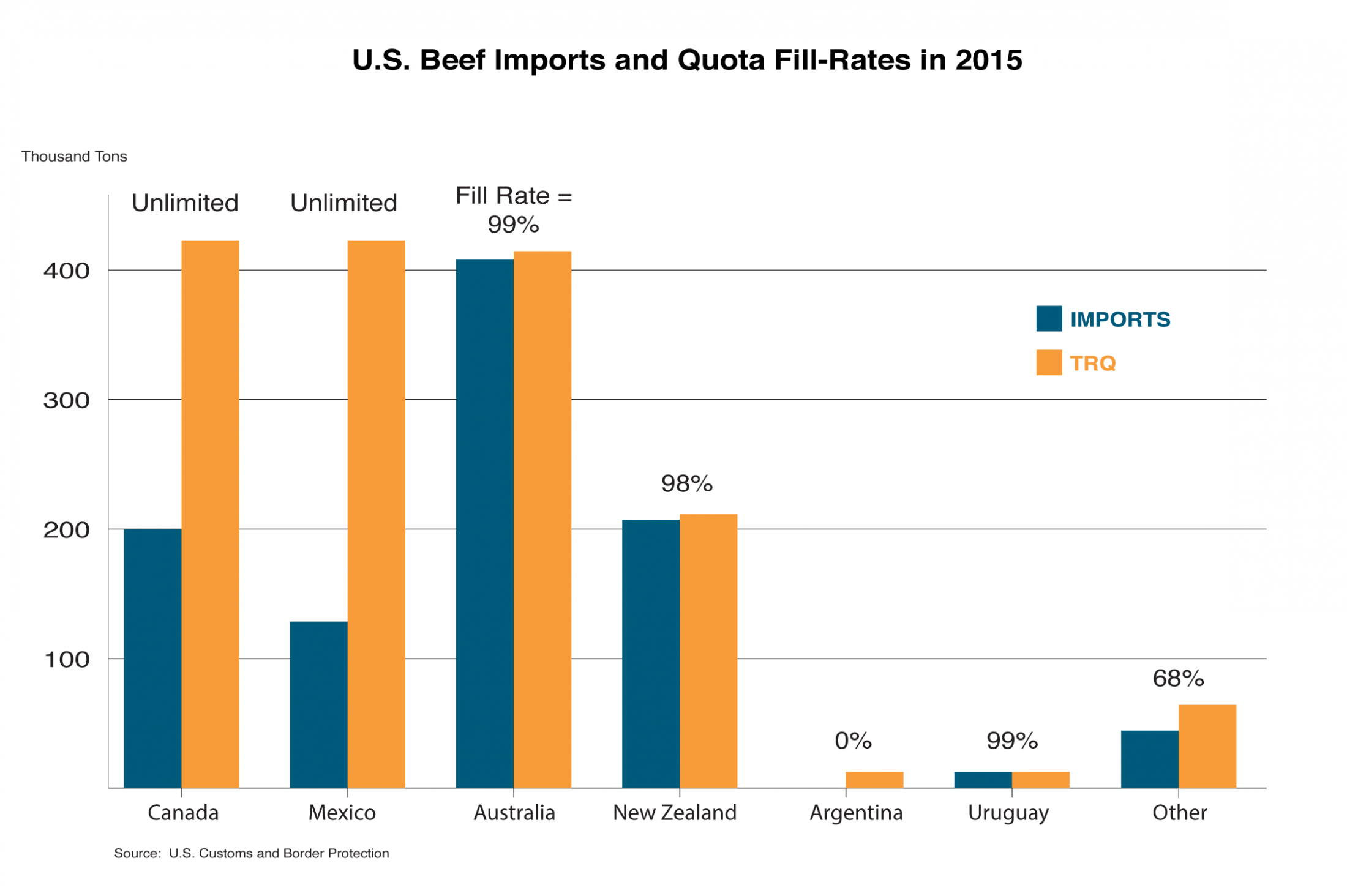
In 2015, the Other Countries TRQ reached a fill-rate of only 68 percent for the vi eligible countries (meet figure), despite strong U.Southward. import need. The fill-charge per unit has climbed over the by 10 years from a depression of 45 pct in 2005 to a loftier of 94 percent in 2011. In one case the WTO quota fills, country-specific TRQs from enacted FTAs volition take effect, allowing an boosted 34,506 tons for CAFTA-DR countries. As agreements are fully implemented, FTA partners will receive unlimited admission, reducing pressure on the Other Countries TRQ.
Quota Allocation
The United States does non intervene in quota allocation; rather this is at the discretion of the exporting countries. For instance, some countries distribute licenses to exporters. Australia maintains a system past which the quota is filled on a outset-come up, first-served basis until reaching a fill up-rate of 85 per centum. The remaining xv per centum is allocated based on historical quota use . The Other Countries TRQ is offered on a first-come up, starting time-served basis to the eligible countries.
Future U.S. Market Access
If additional countries receive APHIS and FSIS approval to ship fresh/frozen beefiness, competition for the Other Countries TRQ is likely to accelerate, at least in the short-term. Nether the current scenario, when a new country becomes eligible, imports could either readapt shipments from other countries or be imported at the in a higher place-quota tariff rate. Later on 2020, contest by existing countries for this TRQ will lessen as CAFTA-DR is fully implemented. Nicaragua, which deemed for near 80 percent of quota use in 2015, will take unlimited access, creating opportunities for other shippers. Further quota expansion could be obtained through futurity WTO negotiations or future FTAs.
i Beef imports include fresh, chilled and frozen muscle cuts under HS headings 0201 and 0202 and exclude candy and prepared products which are not subject to U.Due south. tariff rate quotas.
ii For more than information on requirements, see http://www.fsis.usda.gov/wps/portal/fsis/topics/international-affairs/importing-products.
3 For more than information on Commonwealth of australia'due south quota allotment system, delight see: http://world wide web.agriculture.gov.au/SiteCollectionDocuments/ag-food/quota/blood-red-meat/2014/us-beef-2014-order.pdf
Source: https://www.fas.usda.gov/data/review-us-tariff-rate-quotas-beef-imports
0 Response to "What Is the Tariff Rate of Importing Beef Into the United States"
Post a Comment